 HeyLayla
 Deirdre and Naoise: The Irish Love Story of Choice and Love
Deirdre and Naoise love story, Deirdre of the Sorrows, Irish tragic love story, Deirdre Irish legend, Naoise and Deirdre
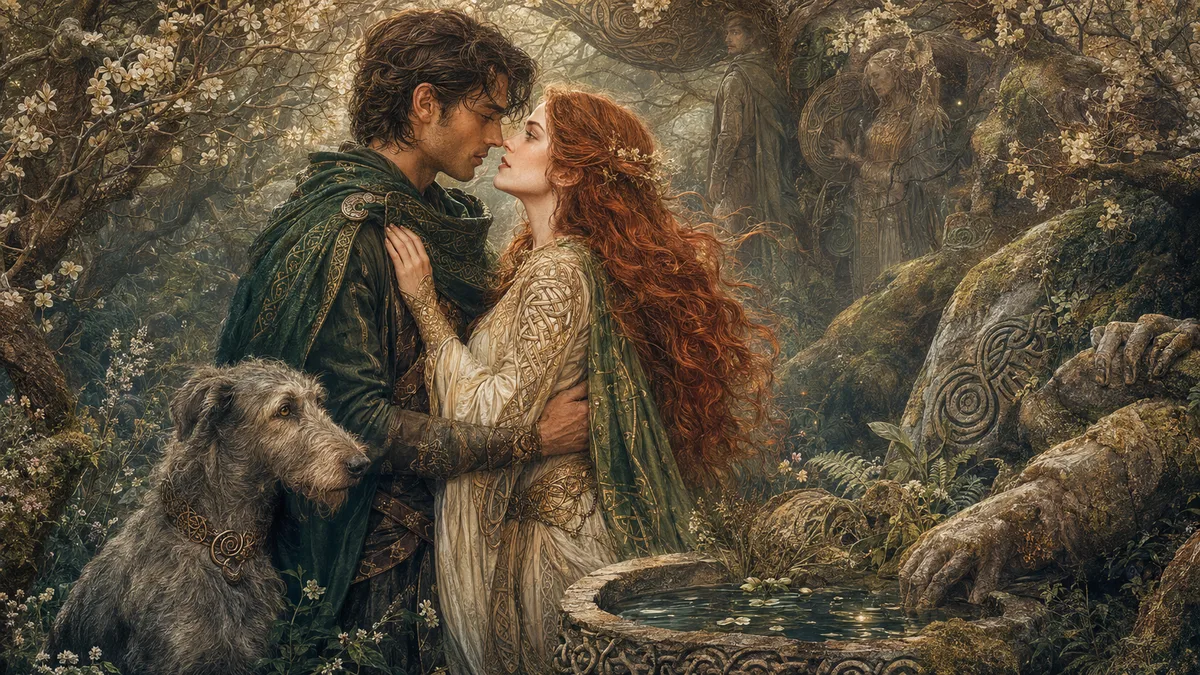
Before Romeo and Juliet, Ireland had Deirdre and Naoise.
Their story comes from the old Irish Ulster Cycle, and like most legends carried across centuries, it has more than one telling.
But every version seems to return to the same painful idea:
What happens when everyone has a plan for your marriage except you?
Deirdre’s life was decided before she could choose it
The story begins before Deirdre is old enough to understand love.
A prophecy says that she will grow into a woman of extraordinary beauty and that sorrow and conflict will follow her.
King Conchobar of Ulster decides that Deirdre will one day become his wife.
So she grows up apart from ordinary life, with her future already arranged around someone else’s wishes.
Then she meets Naoise.
He is young, admired, and one of the sons of Uisneach.
And Deirdre chooses him.
That simple act — choosing for herself — changes everything.
They chose each other, then lost almost everything else
Deirdre and Naoise leave Ulster together.
Naoise’s brothers, Ardan and Ainnle, go with them. The group eventually lives in Alba, the old Gaelic name associated with Scotland.
For a time, Deirdre and Naoise have the thing they were willing to risk so much for:
a life together.
It isn’t the kingdom Deirdre could have had.
It isn’t the future other people planned for her.
But it is theirs.
That may be why the story has survived.
We recognize something deeply human in choosing a modest life with the person you love over a grand life chosen for you.
The tragedy begins when trust is offered
Years later, Conchobar offers reconciliation.
Deirdre, Naoise, and his brothers are invited back to Ulster with assurances of safety.
They return.

The promise is broken.
Naoise and his brothers are killed.
What happens to Deirdre afterward differs among the old tellings and later adaptations, but none gives her the peaceful life she chose with Naoise.
That is why she became known in later literature as Deirdre of the Sorrows.
The tragedy is not simply that two lovers died.
It is that they found each other, chose each other, and still lived in a world determined to make that choice belong to somebody else.
Love needs more than permission to feel
It is tempting to turn old love stories into beautiful tragedies and stop there.
A king.
A prophecy.
Two lovers escaping across ancient Ireland.
Betrayal.
Death.
Wonderful material for poets.
Terrible material for a marriage.
Because people do not need the right merely to feel love.
They need the right to make decisions about their own lives.
Who do I want to know?
Who do I trust?
Who do I want beside me?
And finally:
Do I choose this person?
Those questions sound ordinary compared with an ancient Irish legend.
They are also the foundation of an extraordinary decision.
Advice is different from ownership
Most modern families are not King Conchobar.
But the old story still leaves us with something worth thinking about.
People who love us may have opinions about whom we should marry.
Sometimes those opinions carry wisdom.
Parents may see things we miss. Families know our history. Culture and faith may give marriage meaning larger than two individuals.
That involvement can be valuable.
But advice and ownership are not the same thing.
There is a profound difference between:
“Think carefully about this person.”
and:
“We have decided this person for you.”
A healthy matrimonial process can make room for family without removing the person whose life is actually being decided.
What Deirdre’s story means in the age of HeyLayla
HeyLayla comes from a very different century and a very different culture.
But one principle would have sounded radical in Deirdre’s world:
You choose. Always.
HeyLayla is built for marriage, but nobody on the platform chooses a spouse for you.
There is no public catalog of people. No endless swiping. Introductions are considered, private, and mutual. Nothing moves forward unless both people independently choose it.
Family can be part of the journey when you want them there.
Aunty Layla can help you think.
But neither family, technology, nor Aunty Layla gets the final vote.
You do.
That is not rebellion against family.
It is simply recognizing who will have to live the marriage.
Give the old stories a better ending
We should keep telling stories like Deirdre and Naoise.
Not because love is more beautiful when it ends badly.
But because old tragedies can remind us how valuable ordinary freedom really is.
To meet someone.
To know them.
To listen to the people who care about you.
To think carefully.
And then to say yes because you mean yes.
Deirdre and Naoise had to leave a kingdom to choose each other.
Maybe progress is being able to choose your person without having to run away at all.