 HeyLayla
Mirza and Sahiban: The Punjabi Love Story of Choice and Mercy
Discover the Punjabi legend of Mirza and Sahiban, childhood lovers whose escape from an arranged marriage ended when Sahiban chose mercy over bloodshed.
Punjab has given love some of its most unforgettable names.
Heer and Ranjha. Sohni and Mahiwal. Sassi and Punnun.
And then there are Mirza and Sahiban.
Their story has horses, an escape, angry brothers, a fearless archer and a love strong enough to challenge a marriage arranged by others. But none of those things is what has kept people arguing about Mirza and Sahiban for centuries.
It is the arrows.
Sahiban loved Mirza. Yet when their lives depended on his bow, she took his arrows away.
To understand why is to understand the tragedy.
The love before the legend
Mirza and Sahiban did not meet as strangers at a wedding or catch sight of each other across some royal court. Punjabi tradition remembers them as childhood companions who studied together and grew close long before their names became part of folklore. Their affection matured with them. By the time they were old enough to understand what love meant, they already knew each other.
But knowing whom you loved did not necessarily mean being free to marry that person.
Sahiban’s family arranged her marriage elsewhere. Mirza had been sent away, but distance had not undone what had grown between them. When Sahiban’s wedding approached, word reached him.
Mirza came back for her.
Punjabi imagination remembers him as a formidable archer riding his beloved mare, Bakki. Sahiban chose to leave with him, and together they rode away from the marriage that had been chosen for her.
For a few brief hours, it must have seemed that they had outrun everything.
Family expectations.
Marriage arrangements.
The village.
Perhaps even fate.
But Sahiban’s brothers followed.
The moment that changed everything
Mirza was not afraid of the men coming after them. He trusted his bow, his arrows and his own reputation as an archer.
Sahiban was afraid for precisely the opposite reason.
She knew Mirza could kill them.
And the men he would kill were her brothers.
That is the part of her story that deserves more than a quick judgment.
Sahiban had chosen Mirza. She had left her home with him. She had risked everything to escape the marriage arranged for her.
But leaving with the man she loved had not erased the love she felt for the family she had left behind.
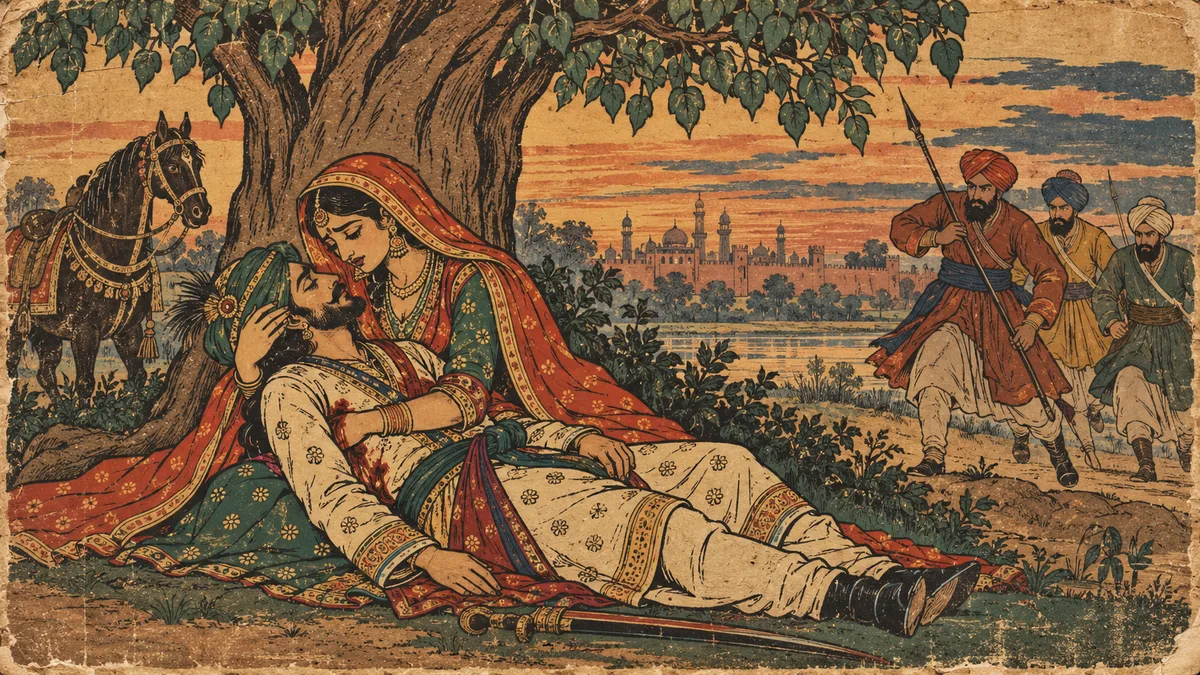
When Mirza stopped to rest beneath a tree, Sahiban faced an impossible possibility: the man she loved might soon have to kill the brothers she loved.
So she acted.
The details change as folk stories often do. In some tellings Sahiban breaks Mirza’s arrows. In others she hides his quiver or hangs it beyond his reach. But the heart of the story remains the same: she removes his ability to kill her brothers because she hopes there can still be another ending.
Perhaps she imagined she could stand between them.
Perhaps her brothers would see that she had chosen Mirza and finally accept it.
Perhaps Mirza would be spared because he had spared them.
For one terrible moment, Sahiban trusted mercy more than weapons.
Mercy did not come.
Her brothers caught them. Mirza reached for the arrows that were no longer there and was killed. Popular versions usually bring Sahiban’s life to an end beside his, although the older and later tellings differ over exactly how her death occurred. The seventeenth-century poet Pilu, associated with the earliest famous literary version of the oral legend, does not give every detail found in later retellings.
Did Sahiban betray Mirza?
That question has followed her almost as long as the love story itself.
She knew her brothers were coming. She knew Mirza’s skill. And she deliberately removed the weapons that might have saved his life.
Read only that far and the verdict seems easy.
But love stories become interesting precisely where easy answers stop working.
Sahiban had already chosen Mirza when she climbed onto his horse and left with him. Her decision with the arrows was not an attempt to return to the life she had escaped.
She was trying to save both worlds.
She wanted Mirza without the blood of her brothers on the beginning of their life together.
She wanted her brothers without surrendering the man she had chosen.
Her mistake was believing she would be allowed both.
That is what makes Sahiban such a compelling figure. Mirza believes his arrows can solve the danger. Her brothers believe force can restore what they think has been lost.
Sahiban alone tries to stop anyone from dying.
And her act of mercy becomes the instrument of tragedy.
Love should not require exile from family
That question feels surprisingly modern.
Choosing someone for marriage does not mean that family suddenly stops mattering. Parents may see risks we do not see. Brothers and sisters may ask uncomfortable but useful questions. Culture, faith, family experience and community can all contribute wisdom.
But advice and authority are not the same thing.
There is a profound difference between a family saying, “We love you, so think carefully,” and saying, “We have decided whom you will love.”
The old Punjabi story pushes that distinction to its most painful extreme.
Sahiban was made to feel that keeping the man she loved meant losing the family she loved.
No one should have to make that bargain.
It is the same question that appears in different forms in Sohni and Mahiwal, The Butterfly Lovers, Deirdre and Naoise, and the story behind HeyLayla’s own name, Layla and Majnun.
Across centuries and cultures, the names change.
The question barely does.
Who gets the final say in a marriage?
The ending Sahiban never received
Perhaps we have spent too many centuries asking whether Sahiban should have broken the arrows.
A better question may be why she ever needed to touch them.
Imagine the same story without the legend.
Mirza and Sahiban know one another. They fall in love. Sahiban tells her family whom she wants to marry. Her family worries. Questions are asked. Arguments happen. Perhaps some people need time.
And eventually two families sit together.
No horse racing into the night.
No brothers in pursuit.
No arrows hidden in a tree.
No lovers dying beneath it.
It would make a much less dramatic folk tale.
But it might make a beautiful marriage.
That ordinary ending was denied to Mirza and Sahiban.
Perhaps the most romantic thing we can take from their tragedy is not the idea that great love must suffer.
It is the hope that great love no longer has to.