 HeyLayla
 Layla and Majnun: Eternal Love, Reimagined for Marriage
The story of Layla and Majnun has survived for centuries. What can their love teach us today about marriage, family, choice, and finding your person?
Long before dating apps, matrimonial websites, profile photographs, or carefully written introductions, there were Layla and Majnun.
Their story has survived for centuries because the feeling at its center is easy to recognize.
Two people find each other.
They love deeply.
And the world around them makes being together almost impossible.
That is what makes Layla and Majnun beautiful.
It is also what makes their story heartbreaking.
A love everyone remembers, but nobody would want to live
Layla and Majnun became symbols of a love so powerful that separation could not destroy it.
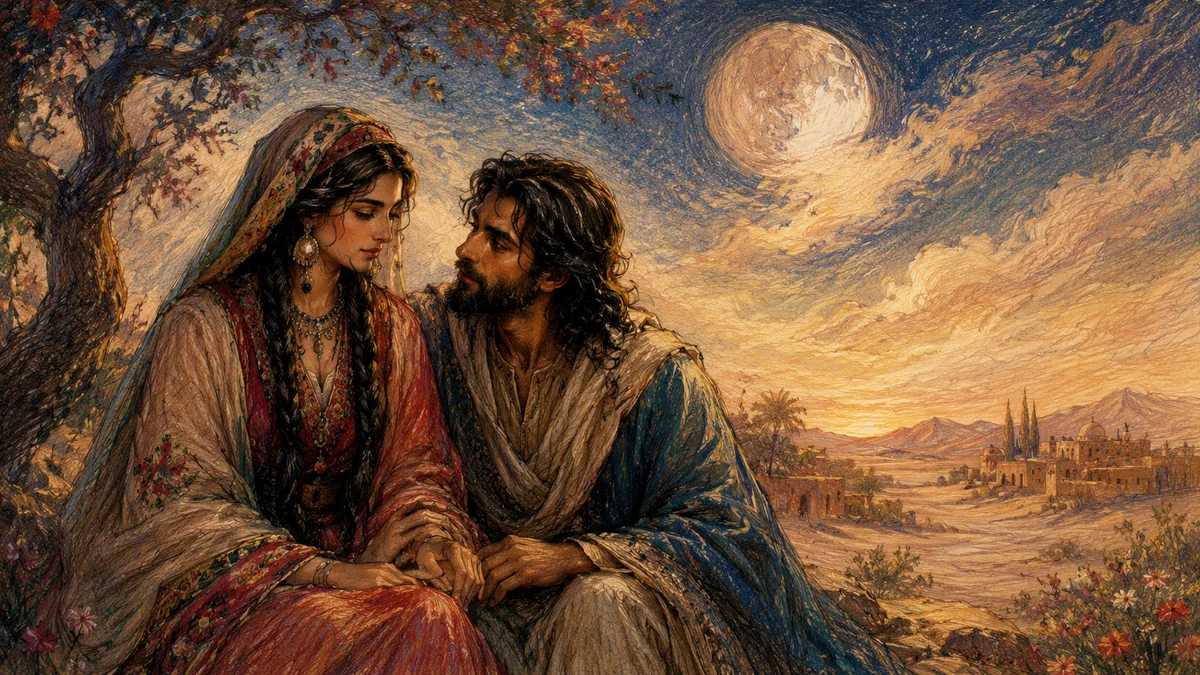
Majnun loved Layla with such intensity that even his name changed. Qays became known as Majnun—the one driven mad by love.
But for all the beauty associated with their devotion, theirs is not really a story about building a life together.
They never got that chance.
Family, social expectations, reputation, and circumstance stood between them. Layla was given in marriage elsewhere. Majnun withdrew further and further from ordinary life.
Their love became eternal partly because it could never become ordinary.
No grocery shopping.
No disagreement over where to spend Eid or Diwali.
No discussion about whose parents are visiting.
No mortgage.
No children.
No Tuesday evening when both people are tired and somebody still has to make dinner.
They became legends.
They never got to become a married couple.
And perhaps that distinction matters.
Real love eventually has to enter real life
Romantic love often begins in extraordinary moments.
Marriage lives mostly in ordinary ones.
It is one thing to miss someone so deeply that poetry comes from it. It is another to build a peaceful home with that person.
Can you talk when you disagree?
Can you respect each other’s families without letting those families make every decision?
Can you discuss faith, money, children, work, privacy, responsibility, and the life you want to build?
Can you choose each other when the relationship is no longer a beautiful idea but everyday life?
Those questions are less poetic than eternal longing.
They may also matter more to a marriage.
Family should matter. So should your choice.
There is another reason Layla and Majnun still feels familiar, especially across cultures where marriage has traditionally involved more than two individuals.
Family matters.
For many of us, that is not a burden. It is part of who we are.
Parents carry experience. Culture carries memory. Faith can shape how we understand marriage itself. Family approval may matter deeply.
But there is a difference between family being part of your decision and family making the decision for you.
Layla and Majnun lived inside a world where that distinction left them very little room.
A modern matrimonial journey can do better.
You should be able to respect where you come from without surrendering the decision about where your own life goes.
Family can open a door.
You still have to decide whether you want to walk through it.
Maybe eternal love needs a different ending
This is where the name HeyLayla takes on an interesting meaning, even without pretending that a centuries-old romance is a blueprint for a modern matrimonial platform.
The old Layla could not freely build a life with the person she loved.
HeyLayla begins from almost the opposite principle:
You choose.
There is no endless public catalog of people.
No swiping through human beings as though the next one might always be better.
Introductions are considered rather than endless. Interest has to be mutual. Personal information can unfold gradually. Family can matter without standing over your shoulder.
And Aunty Layla can offer guidance when you need it.
But she does not choose your person.
Nobody should.
Love is not proved by suffering
Perhaps this is the part of Layla and Majnun worth reconsidering most.
We have inherited many beautiful stories in which great love is measured by how much the lovers suffer.
But a good marriage should not need tragedy to prove that the love was real.
Maybe love can be deep without being impossible.
Maybe devotion can mean showing up instead of disappearing into the desert.
Maybe the person you love does not need to become an unreachable ideal.
Maybe you can actually sit across the table from them, know them as they really are, choose each other freely, and then begin the much less poetic—but far more interesting—work of building a life.
Layla and Majnun gave us an unforgettable story of love that could not become a marriage.
Perhaps the modern hope is simpler.
Find your Layla.
Find your Majnun.
Then give the story a better ending.